The entire fifth day is devoted to exploring Fez, one of Morocco’s most fascinating cities in terms of culture, history, and religion. Part of the day will be spent with a guide, while the other part is free for independent exploration.
During the guided portion, a certified local guide will lead you through the city’s historic neighborhoods, where the charm lies not only in their architecture but in their authentic atmosphere. Highlights include the Karaouine Mosque, home to a university considered by many as the oldest in the world, dating back to the 10th century. You will also visit the beautiful medersas, such as Bou Inania and Attarine, along with other notable historical sites that showcase Fez’s rich heritage.
In the afternoon, enjoy free time to explore at your own pace. The medina’s craft stalls are a must-see, offering handmade goods from carpenters, goldsmiths, potters, and other artisans. You can also visit the city’s museums, such as Borj Nord with its collection of period weapons, or the Nejjarine Museum, dedicated to wooden art and craftsmanship.
The day concludes with another overnight stay in your centrally located riad, allowing you to rest and reflect on the city’s wonders.
Day 6:Fez – Ifrane – Monkey forest – Erfoud – Erg Chebbi Dunes
The midpoint of this 12-day tour marks the day we venture farthest into the heart of the Sahara Desert. But before reaching the dunes, the journey offers many remarkable stops along the way.
Our first stop is Ifrane, a town with gable-roofed houses, green parks, and a surprising Alpine-like atmosphere. Its location in the Middle Atlas at 1,700 meters altitude brings abundant rainfall, often falling as snow in winter.
Nearby, we visit Ifrane National Park, also known as Monkey Forest, home to the Barbary macaque. Here, you will also see majestic century-old cedar trees and fast-flowing streams, making the park a truly scenic stop.
Continuing across the Middle Atlas, the route opens into the arid beauty of the Ziz Valley, leading us toward the desert. Erfoud is our next stop, famous for shops selling fossils, before we reach Merzouga, a small desert village at the edge of the dunes of Erg Chebbi.
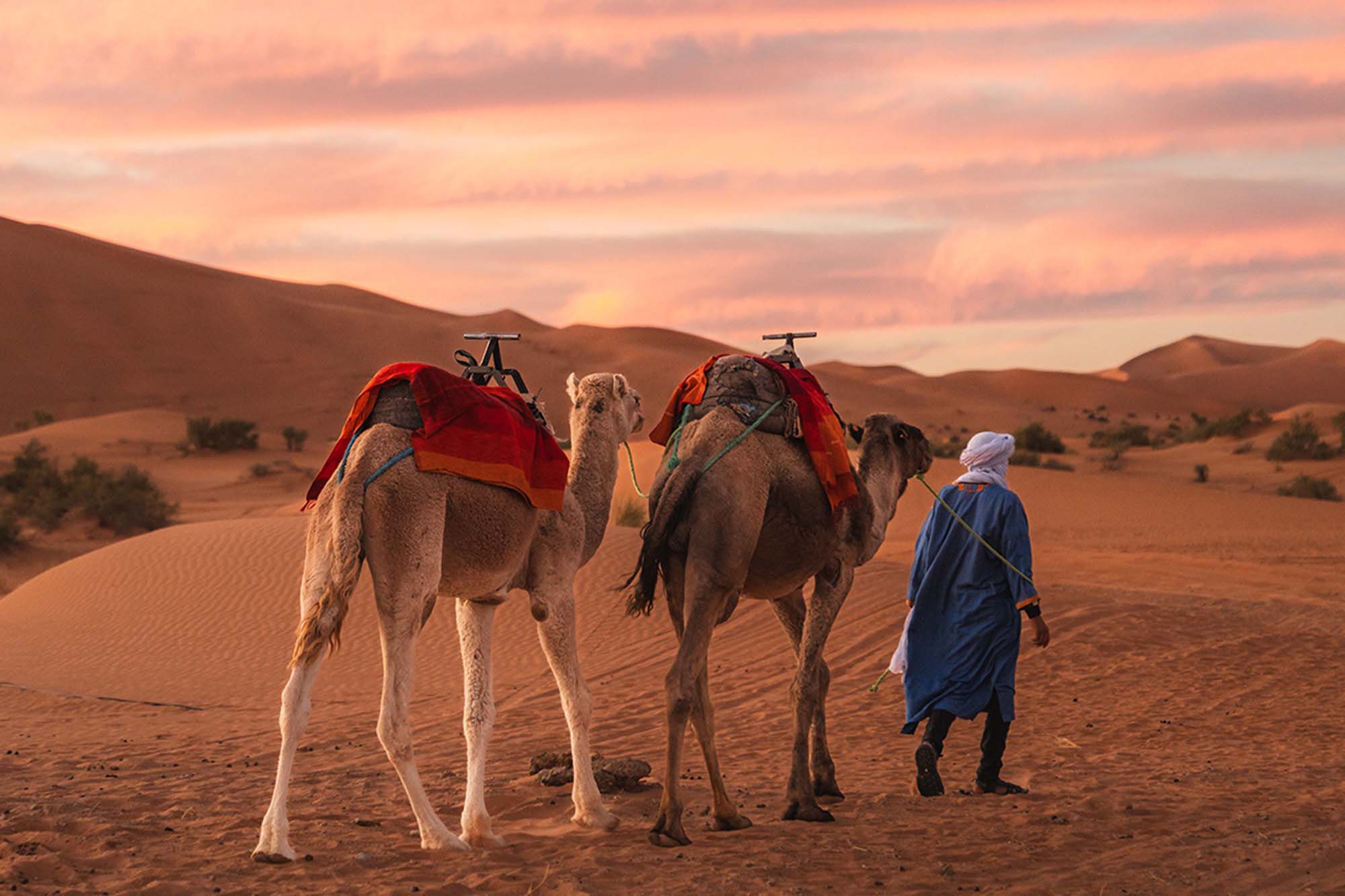
Here, we embark on a camel trek, the traditional way to navigate the soft sand dunes, and arrive at our desert camp. Enjoy a welcome tea, a delicious dinner, and the mesmerizing night sky filled with stars before retiring to one of the comfortable Berber tents for an unforgettable overnight stay.
Day 7: Erg Chebbi Dunes – Visit to nomads – Khamlia – Merzouga Desert
One of the highlights of staying in the Erg Chebbi dunes is waking up surrounded by sand, especially early in the morning to watch the sunrise over this vast golden landscape. After admiring the magical dawn, we’ll enjoy breakfast at the camp and begin our return journey to Merzouga.
From there, the adventure continues on a 4×4 through remote desert tracks, unpaved roads, and hammada terrain. One notable stop is Khamlia, known as the “Black Village” due to the skin color of most of its inhabitants. Descendants of former slaves brought along caravan routes, they are now the guardians of Gnawa music, recognized by UNESCO as Intangible Cultural Heritage. Here, we will experience their rhythms and melodies in an unforgettable performance.
Another stop will take us to semi-nomadic Berber settlements, where the local population continues a traditional lifestyle largely disconnected from the modern world. They will share their hospitality and daily routines, offering a unique cultural insight.
On the way back to Merzouga, we’ll pause at a viewpoint to take in the sweeping panorama of over 25 kilometers of dunes. The day concludes with dinner and a comfortable overnight stay in a hotel designed with traditional desert architecture and interiors.
Day 8: Merzouga Desert – Rissani – Todra Gorges – Dades Valley – Ouarzazate